Five Questions Every CMO Should Be Asking About AI Right Now
September 18, 2026

Enterprise AI is moving past its initial wave of access and experimentation. In that first phase, organizations deployed tools across teams to see which daily tasks they could automate and where they could save time.
The current phase leads us to question what happens when AI begins changing how the enterprise operates.
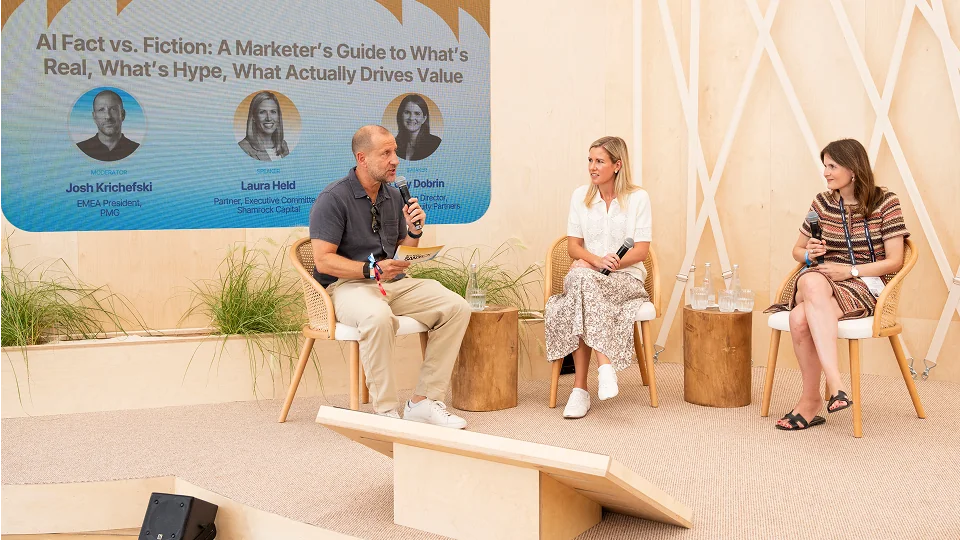
At the inaugural AI & Tech Sandbox event, I spoke with and listened to leaders across marketing, technology, investment, and media who emphasized that AI’s highest value extends well beyond task automation. It became apparent that the real opportunity lies in unifying technology, data, creativity, and talent to sharpen decision-making and unlock commercial value.
Both on stage and in our podcast conversation following, Laura Held, Partner at Shamrock Capital, highlighted this shift. She noted that while companies initially focused on driving efficiency and margin, the greater potential lies in enabling new revenue streams and commercial opportunities.
With boards and CEOs expecting marketing to lead AI transformation, the CMO's remit is expanding. This sentiment was backed in an article I read by Jay Pattisal, VP, Principal Analyst at Forrester, and speaker at the AI & Tech Sandbox.
He said: “Today, CMOs are expected to translate AI capabilities into business outcomes. Forrester’s research shows that CMOs are nearly as likely as COOs and CIOs to be the primary executive in charge of AI business strategy.” (Source: Forrester)
Marketing sits where customer intelligence, brand strategy, technology, and growth collide. As AI converges these functions, few leaders are better positioned than marketers to lead the organizational charge. Five strategic questions define how marketing leaders can navigate this transition.
1. Are we transforming how we operate, or just running existing processes faster?
The most common AI use cases focus on immediate task efficiency, such as summarizing information, drafting content, analyzing datasets, and speeding up research. While cumulative time savings across an enterprise are real, task-level efficiency captures only a fraction of AI’s potential.
True transformation requires redesigning operating rhythm around continuous feedback loops, and Independent Analyst Benedict Evans framed this distinction, observing that most organizations currently use AI to produce existing outputs at higher volumes, therefore missing out on a huge amount of potential value.
When execution becomes faster and lower-cost, leaders can redesign entire workflows. A marketing campaign traditionally staged across distinct phases of research, production, activation, and measurement can shift to a continuous feedback loop. Strategy adapts to live market signals, creative iterations respond dynamically to performance data, and teams test hypotheses in real time.
Unlocking decision velocity requires an operating model, not a tool rollout—connected technology and cross-functional teams working against operating rhythms that are measured by business outcomes rather than volume. As Evans noted, handing employees a chatbot without restructuring ways of working does not constitute an operating model.
The critical inquiry for leadership is identifying where AI can fundamentally reshape how work gets done.
2. Where will our competitive advantage come from when everyone uses the same tools?
Advantage no longer comes from technology access alone now that foundational AI tools are widely accessible. Differentiating a business requires connecting standard models to proprietary organizational knowledge—first-party data, brand rules, historical performance, and human expertise.
Integrating these internal assets transforms general-purpose tools into custom, enterprise-specific capabilities.
Organizations risk stalling in isolated pilot phases without structured ways of working and governance connecting AI tools to daily operations. Snapchat’s Valentina Culatti highlighted this barrier at the Sandbox, observing that a lack of agentic architecture keeps teams trapped in fragmented trials. Overcoming that gap requires embedding technology into company-wide routines, exemplified by Pacsun CEO Brieane Olson’s long-term roadmap and weekly AI council.
Sustainable advantage comes from turning standard AI capabilities into proprietary business execution.
3. How will customers discover our brand as AI changes the interface?
As consumers adopt conversational assistants and autonomous agents, discovery is shifting from manual search queries to synthesized recommendations. In this environment, brand visibility depends on machine comprehension alongside consumer awareness.
Marketing leaders must extend visibility strategies beyond traditional SEO into answer engine optimization, ensuring product data, pricing, and messaging are structured for AI systems to parse accurately. At the AI & Tech Sandbox, Google Cloud’s Oliver Parker described AI as a discovery engine querying foundational data to surface insights—meaning public-facing information must be clear and machine-readable.
Because AI agents curate options directly for consumers, accuracy dictates what gets surfaced. Wall Street Journal SVP Phillipa Leighton-Jones underscored this imperative, noting that public data requires rigorous fact-checking. Ultimately, securing market share now demands a dual strategy engineered for both human audiences and AI algorithms.
4. How do we maintain brand authenticity as synthetic content expands?
As generative AI lowers content production costs, media channels are filling with automated material. Creator Tom Scott noted at the AI & Tech Sandbox that while low-quality content has always existed, its current volume is leading consumers to tune out generic messaging.
The more of it there is, the more originality is worth. While AI streamlines back-end production, asset versioning, and analytical reporting, audience engagement still depends on distinct human qualities—taste, cultural intuition, humor, and editorial voice.
Reddit CEO Steve Huffman pointed out that as clean, automated answers become ubiquitous, messy, multi-perspective human discussion becomes more valuable to searchers.
Information integrity is critical in its own right, alongside the community engagement and creator partnerships brands are already building. Harriet Kingaby, Co-Chair of the Conscious Advertising Network, emphasized that managing AI-related information risks today protects long-term brand equity and creative effectiveness.
The CMO's role is to establish clear parameters governing where automation drives efficiency and where human direction remains mandatory to safeguard audience trust.
5. How are we measuring AI’s commercial impact beyond software efficiency?
Most enterprise AI scorecards currently track operational metrics such as hours saved and assets produced. While these numbers demonstrate initial adoption, productivity gains alone do not prove commercial value if saved hours are not reallocated toward growth.
Transitioning from efficiency to impact requires evaluating how AI accelerates revenue. Leaders must track metrics tied directly to business performance, such as campaign time-to-market, customer acquisition efficiency, pipeline velocity, and incremental revenue generation.
Connecting AI initiatives to commercial outcomes ensures technology investments compound rather than decay into routine cost overhead. Moving beyond margin preservation to open new revenue streams is where AI delivers its highest return.
Therefore, the enterprise CMO must establish evaluation frameworks that connect technical capabilities to board-level financial performance.
What’s your organizational advantage?
Navigating this next stage of AI requires moving beyond ad-hoc experimentation and isolated software wins.
Because marketing integrates customer insight, brand voice, media deployment, and performance analytics, CMOs are in a pivotal position to lead enterprise AI strategy. Unifying these capabilities into a cohesive operating model enables companies to evaluate market signals faster and execute with precision.
Long-term advantage hinges on turning widespread tool access into a proprietary operating capability.
Up Next
Recommended content for you