Beyond the Hype: Why the Next Wave of AI ROI Belongs to the Coordinated Enterprise
September 17, 2026

Summary of Key Takeaways
- As LLM models become commodity infrastructure, access alone is not a competitive advantage. Real commercial impact comes from operationalizing intelligence across proprietary data, workflows, and decisions.
- Fragmented AI tools produce fragmented intelligence. Enterprise value requires moving past standalone chatbots to an integrated operating framework spanning connected technology, embedded talent, and workflow redesign.
- AI transformation is an operational redesign challenge, not a software purchase. The biggest gains come from changing how work gets done—shifting focus from automating legacy tasks faster to accelerating decision velocity.
- AI ROI must be measured by business outcomes, not output volume. Lowering the cost of generation risks creating activity without value; success belongs to the enterprise best engineered to act on intelligence.
AI has no shortage of capability. The harder question is whether organizations are built to turn that capability into commercial value.
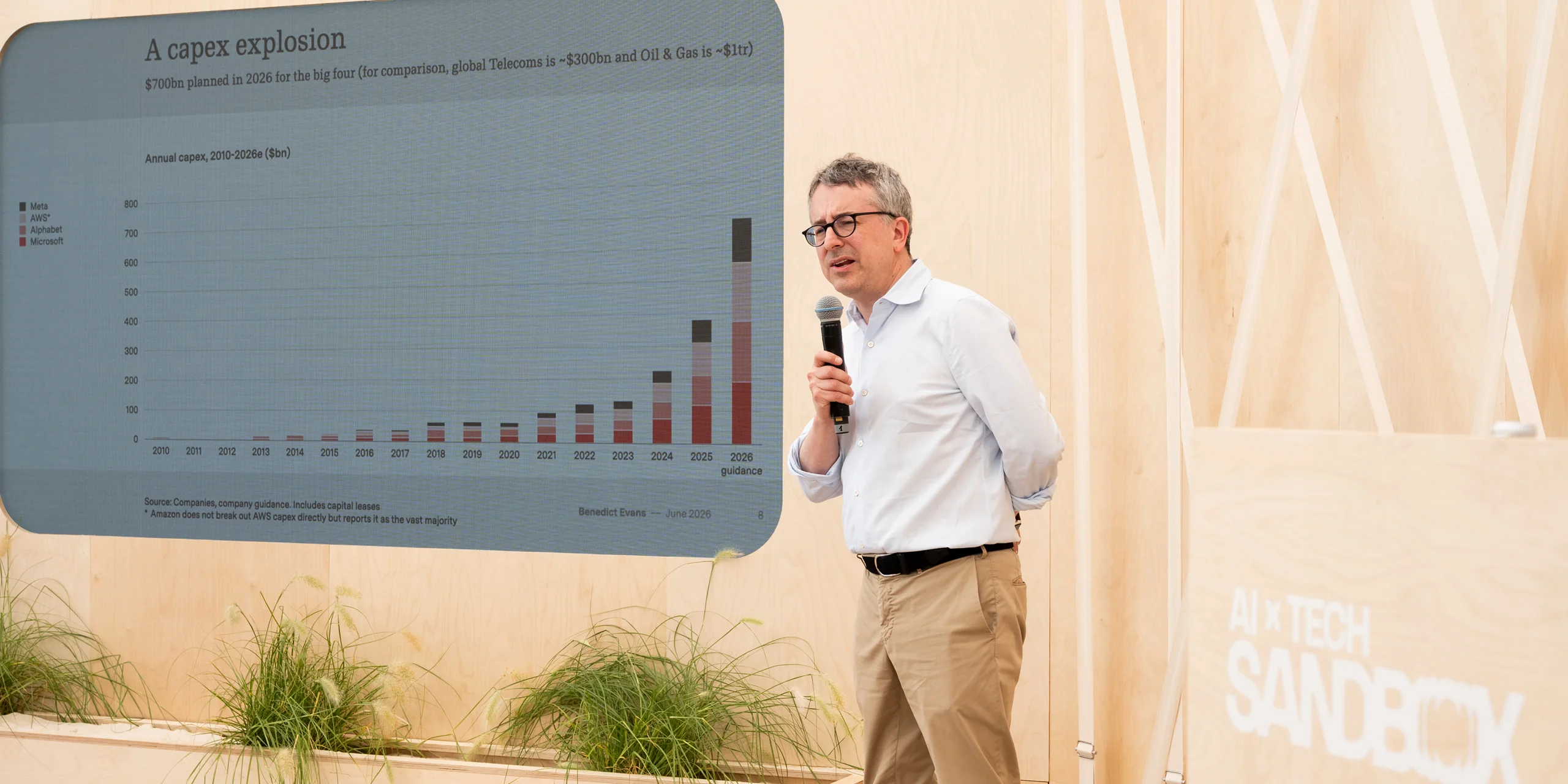
In his keynote, “AI Eats the World,” presented at the AI & Tech Sandbox during Cannes Lions, independent analyst Benedict Evans framed generative AI as the latest in a series of major platform shifts. As with the mainframe, PC, web, and mobile, the technology itself is only part of the story. The bigger question is what happens once businesses absorb it and begin changing how they operate around it.
That question is becoming more urgent as the underlying models increasingly resemble commodity infrastructure. Evans argues that value will move “up the stack,” away from the models themselves and toward the applications, workflows, and systems built around them.
For brands, that changes the AI conversation.
If everyone has access to increasingly capable models, access alone is not a competitive advantage. The real commercial impact of AI will come from how organizations operationalize that intelligence and connect it to proprietary data, workflows, people, and decisions.
At PMG, we see this shift through three lenses:
- From fragmentation to coordination
- From software purchase to organizational change
- From AI activity to business value
From Fragmentation to Coordination
The first wave of enterprise AI has created no shortage of tools. Teams are experimenting with copilots, chatbots, content generators, analytics platforms, and an expanding range of specialized point solutions.
But more tools do not necessarily create more value.
Fragmented systems can produce fragmented intelligence. Insights are generated in one part of the organization while decisions happen somewhere else. Data sits across disconnected platforms. Teams adopt AI independently, creating new silos rather than removing old ones.
That is why the emerging advantage is not simply data. It is coordination.
PMG’s view is that AI creates the most value when data, technology, strategy, and execution are connected through a shared operating model and common ways of working. Adding another disconnected tool rarely solves the underlying problem.
As Evans explains, giving employees access to a chatbot and expecting them to determine how it should transform a business process is not an operating model. AI’s capabilities are also uneven, operating along what is often called a “jagged frontier,” where models can be exceptionally capable at one task and surprisingly weak at another.
The opportunity is to structure AI around real workflows.
Bridging the gap between powerful models and commercial transformation requires moving beyond standalone software purchases toward true agentic enablement. Realizing that value requires an integrated operating framework built on three pillars:
- Centralized Operating Technology: A connective intelligence layer built on top of increasingly commoditized models, linking strategy, activation, and measurement while directing real-time data and intelligence to the people and systems responsible for making decisions.
- Embedded Technical Talent: Software engineers and product architects working directly alongside business strategists and functional teams to translate complex operating requirements into automated, scalable workflows.
- Organizational Change Management: Redesigning workflows around intelligent systems, upskilling teams, clarifying human and machine responsibilities, and evolving commercial models from legacy measures such as billable hours toward decision velocity, business performance, and measurable outcomes.
From Software Purchase to Organizational Change
The second shift is recognizing that AI adoption is not primarily a procurement exercise.
Buying technology is relatively easy. Redesigning an organization around what that technology makes possible is much harder.
Evans observed that most large companies are not naturally structured to ask how a new technology could fundamentally change the way they work. That is why AI transformation is ultimately an organizational and change-management challenge.
Much of today’s AI adoption still falls into what Evans describes as “doing the old stuff more.” Companies use AI to draft more content, create more summaries, automate more reports, or complete existing tasks faster. Those efficiencies matter, but they represent only the first stage of a technology shift.
History shows that the larger gains come when technology changes the work itself.
Spreadsheets did more than accelerate calculations. They expanded the range and complexity of what financial professionals could analyze. Barcodes were introduced to improve checkout efficiency, but their greater impact came from real-time inventory intelligence, which allowed supermarkets to carry more products and helped create entirely new commercial markets.
AI presents leaders with a similar set of questions.
If a process that once took a week can now happen in minutes, how should the team use the time that is freed up? If every customer interaction can be analyzed instead of a small sample, how should that intelligence change the next decision? If an automated workflow can respond in real time, which legacy processes, structures, and approval layers no longer make sense?
These are organizational questions, not software questions. Increasingly, leaders will need clear answers to them.
From AI Activity to Business Value
That leads to the third shift: changing how AI success is measured.
Organizations can point to growing levels of AI activity, including more licenses, more users, more generated content, and more automated workflows. But activity is not the same as value.
The better questions are commercial.
Are decisions happening faster? Are they becoming more accurate and effective? Is intelligence reaching the people who can act on it? Is automation reducing friction and cost? Is AI enabling strategies that were previously too expensive, complex, or slow to pursue?
PMG’s view is that AI ROI should ultimately be measured through decision velocity, decision quality, operational efficiency, customer impact, and business performance, not simply by the volume of content, reports, or automated tasks produced.
This distinction matters because cheaper automation can just as easily create more activity. Evans points to the Jevons Paradox: when the cost of an activity falls, organizations often do much more of it.
More output does not automatically create more value.
The goal is not to maximize the amount of AI inside an organization. It is to build an operating model in which AI improves consequential decisions and contributes to measurable commercial performance.
The Coordinated Enterprise
Together, these shifts point toward the next phase of enterprise AI.
The winners will not necessarily be the organizations with the most tools, the most sophisticated model, or the greatest volume of AI-generated output. They will be the organizations that build the strongest system around intelligence.
A coordinated enterprise connects data, technology, workflows, and human expertise so that intelligence does not stop at the point of generation. It moves through the organization, reaches the right decision-maker, and changes what happens next.
That will matter even more as AI becomes ubiquitous. Evans notes that generative AI is naturally good at producing the statistical average: what most people would probably say or do. Competitive advantage still requires judgment. It requires knowing when to follow the pattern, when to break it, and how to apply proprietary context in ways competitors cannot reproduce simply by accessing the same model.
That brings us back to the central question Evans posed to the industry:
“What was impossible that now becomes cheap? And how does that actually change the whole structure of the market?”
Answering that question requires moving beyond the hype and recognizing that AI transformation is an operational redesign challenge, not a software procurement task.
Realizing the commercial promise of AI requires moving beyond passive chatbot experimentation toward true agentic enablement. It requires connecting proprietary data, operating technology, human judgment, and strategic talent into a coordinated decision system.
The next wave of AI ROI will not belong to the organizations generating the most AI activity. It will belong to the organizations best engineered to turn intelligence into action.
Up Next
Recommended content for you